


The Arm-Swinging Exercise (Phất Thủ Liệu Pháp) – A Traditional Healing Practice
The breathing movements coordinated with continuous arm swinging work on the chest and abdominal muscles, especially the diaphragm, helping to massage the internal organs, promote the circulation of qi and blood, and enhance the function of various organs. It also helps clear blockages and stagnation in the meridians or organs. Fundamentally, the Yi Jin Jing (Muscle-Tendon Change Classic) takes the free flow of qi and blood as its core principle—when qi and blood circulate freely, they carry fresh blood to nourish all parts of the body and flush out accumulated waste.
Basic Instructions
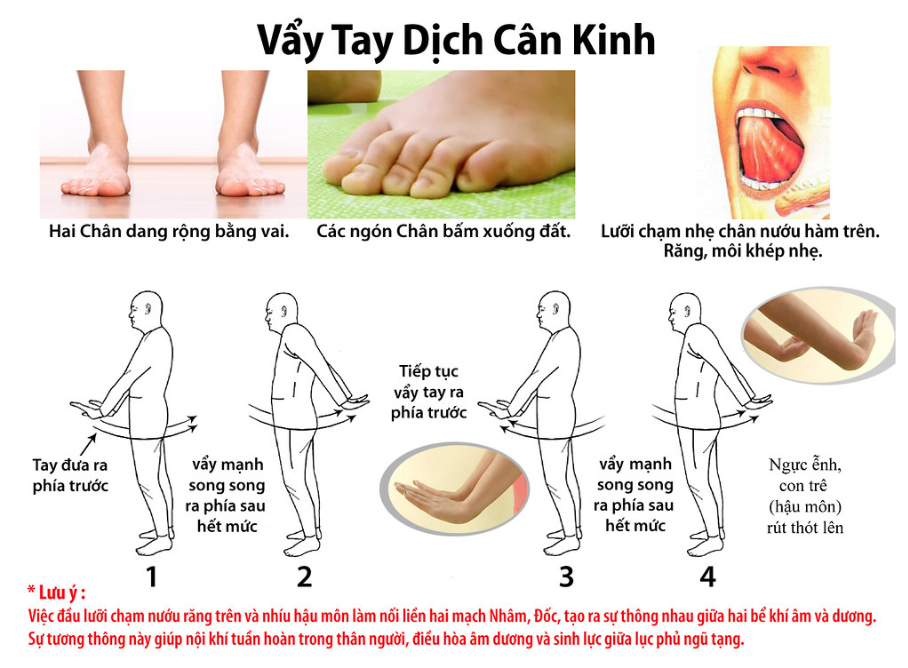
Stand with your feet shoulder-width apart.
Extend both arms straight out at shoulder level, fingers spread and straightened, palms facing backward.
Pull in your lower abdomen, keep your back straight, head and mouth relaxed, tongue touching the upper palate, teeth gently closed, and mouth shut.
Press your toes firmly into the ground, heels touching the earth, calves and thighs tense and strong.
Choose a distant point to focus your gaze on. Don’t let your mind wander—keep your attention on your toes gripping the ground. Keep your thighs and calves firm. Tighten your anus, tongue touching the upper palate, and count silently.
Use force from your shoulder blades to swing both arms backward. When your hands return forward, let them fall naturally with momentum—absolutely do not use force. However, keep your legs tense, anus contracted and tight, tongue still touching the upper palate.
For your first session, swing 200-300 times, gradually increasing to 1,800 swings (approximately 30 minutes).
You must have determination and focus on consistent practice. Don’t rush or practice excessively, as haste makes waste. But also don’t practice randomly—sometimes a lot, sometimes a little, or skipping sessions—as this will undermine your confidence and make it hard to see results.
Detailed Practice Method
Mindset First:
You must have spirit and determination—commit to practicing thoroughly, steadily, and confidently. Don’t be discouraged by others’ opinions and give up halfway. Stay optimistic.
Posture:
Find a cool, well-ventilated place with fresh air. Wear loose, comfortable clothing. Stand straight, feet shoulder-width apart, all ten toes gripping the ground firmly (wear thin-soled shoes or slippers) as if walking on slippery ground. Center your weight on the balls of your feet, heels touching the ground. Tense your legs and tighten your anus.
From the waist up, stay relaxed. Let your arms hang loose and open, palms facing backward. Keep your head and neck relaxed, don’t think about anything—just concentrate on counting how many swings you’ve completed. Eyes focus on a single distant point ahead. Keep your mouth slightly open to allow air to circulate.

Use force to swing your arms backward, then let them drop forward naturally with momentum—but only 3/7 of the distance compared to the backward swing. Then swing backward again. Here, your arms work like oars anchored deep in your shoulders. When they move, they pull the diaphragm along, raising and lowering it like a piston in a pump.
The key principle is 3-7: “Front 3, back 7” and “Top 3, bottom 7.”
“Front 3, back 7” means your arms go 3 parts forward and 7 parts backward—essentially, no force forward, full force backward.
“Top 3, bottom 7” means the upper body is 3 parts stable while the lower body is 7 parts—or “heaven light, earth heavy”—which aligns with Eastern philosophical principles.
The arm-swinging motion must be persistent, steady, gentle, and fluid. Don’t force your arms backward with excessive strength—just use normal force, coordinated with your body’s natural breathing rhythm. The forward motion is created by the momentum from the backward swing. Throughout the swinging process, even though your arms move back and forth, maintain a relaxed, natural state—don’t tense your arms.
Perform many repetitions continuously. You can practice 1-3 times per day. For therapeutic purposes, each session should include 1,800 or more swings.
Keep your eyes looking straight ahead, mind free of thoughts, silently counting the number of swings.
The same goes for tightening your anus and pressing your toes into the ground—use just enough force to maintain psychological comfort and physical endurance so you can practice thousands of swings per session.
Practice Duration:
The initial phase is for your body to adapt. Don’t strain and injure your toes or shoulder joints. Don’t be impatient—haste makes waste, and you won’t achieve the desired results. With determination and gradual progress, you’ll achieve satisfying results. Rushing will prevent your body from adapting properly.
In the beginning, depending on individual capacity, those accustomed to exercise can start with 300 swings per session. Those less active can begin with 100 or 200 swings. Once comfortable, gradually increase by 100 swings per session. Weaker or less active people can increase by 50 swings per session, working up to 1,800 or more swings per session and maintaining that until recovery.
Throughout the practice, for therapeutic purposes, remember to practice regularly and consistently—three sessions daily. Morning practice should be vigorous when your mind is clear; afternoon practice before eating should be moderate; evening practice should be gentle. Note that vigorous evening practice can cause insomnia, as strong blood circulation stimulates the nervous system and makes sleep difficult. Once adapted, it creates refreshment and deeper sleep. An average session lasts 30 minutes, meaning you need to maintain at least 1,800 swings per 30 minutes to ensure proper blood pumping.
When you reach 600 or more swings, you’ll often experience passing gas, sneezing, leg soreness, sweating, and facial flushing—these are all normal phenomena, no need to worry. Passing gas and sneezing occur because intestinal peristalsis increases, boosting digestive function. Leg soreness happens because qi and blood concentrate downward, aligning with the universal principle of “heaven light, earth heavy”—this is the law of life harmonizing with the cosmos.
As mentioned above, remember when starting practice to avoid injuring your toes (after each session, massage each toe 9 times). Being impatient and wanting quick recovery by using excessive force won’t bring results. Have determination but progress gradually—that’s the right way to achieve good results. If your mind isn’t focused and your thoughts are scattered, qi and blood will scatter chaotically, and neglecting “top light, bottom heavy” will lead to failure.
The Mechanism of Arm-Swinging Therapy
The breathing movements coordinated with continuous arm swinging work on the chest and abdominal muscles, especially the diaphragm, helping to massage internal organs, promote the circulation of qi and blood, and enhance organ function. It also clears blockages and stagnation in the meridians or organs. People with sluggish digestion will experience gas passing or burping after about 500-700 swings, with a very clear sense of relief. Yi Jin Jing – Arm-Swinging Therapy is the simplest method for treating stomach pain or digestive disorders. Cases of qi blockage, qi obstruction, or qi stagnation due to stress, illness, or incorrect qigong practice can also be cleared through Yi Jin Jing.
Liver disease occurs because poor qi and blood circulation in the liver causes qi accumulation, making it difficult for the liver to excrete, thus affecting the bile ducts and even the spleen and stomach. Practicing Yi Jin Jing can resolve this problem—if gas passes early, that’s a good sign. Regarding eye diseases, practicing Yi Jin Jing can cure red, painful eyes and common eye problems, myopia, and even cataracts. Traditional medicine says that eyes depend on blood to see; when qi and blood don’t reach the parts of the eyes, various eye diseases arise. The eyes are not only the visual organ but also an important part of the body.
According to traditional medicine and ancient qigong philosophy, humans and the universe harmonize through breathing. Two French scientists, Jacqueline Chantereine and Camille Savoire, also concluded: “Cosmic force enters humans at the head and exits at the right foot; the earth’s yin force enters humans at the left foot and rises to the crown at the back.” The movements of Yi Jin Jing – Arm-Swinging Therapy, though simple, directly harness this principle for healing and strengthening internal qi, opening the qi, blood, and meridian channels in the body.
If you’re unfamiliar with the 12 meridians: they consist of 6 yin and 6 yang meridians running along the limbs and torso, front and back. There are also collateral branches from the meridians forming networks that circulate qi energy and vitality through all parts and tissues.
In 1992, at Necker Hospital in Paris, Dr. Jean-Claude Darras and Dr. Pierre de Vernejoul conducted a famous experiment. They injected harmless radioactive tracers into the acupuncture points of 300 volunteers and tracked their movement with gamma cameras. When injected into acupuncture points, the tracers moved regularly along meridian pathways, matching descriptions in acupuncture texts. But when injected at non-acupuncture points, they dispersed and disappeared.
They also found that tracers moved more slowly around diseased organs and faster around healthy ones, confirming the concept of disease as energy blockage.
This experiment confirmed the existence of the meridian network, something that some modern medical opinions had previously dismissed and ridiculed.
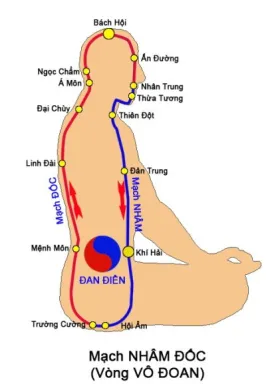
The Ren and Du Vessels: Besides the 12 meridians linked to internal organs, there are 8 extraordinary vessels where the 12 meridians intersect, including the Ren and Du vessels.
The Du vessel is the vessel of yang meridians, located along the spine, where all yang meridians from the hands and feet converge.
The Ren vessel is the vessel of yin meridians, located along the front of the abdomen, where foot yin meridians converge.
When practicing Arm-Swinging, in the upper body, the breathing and arm-swinging movements activate the Baihui point at the crown and the Dazhui point between the shoulder blades to gather heavenly qi, opening and strengthening the yang meridian channels. Baihui and Dazhui are both convergence points of yang meridians and the Du vessel.
Below, tightening the anus and pressing the toes into the ground stimulates the Changqiang and Huiyin points on both sides of the anus and the well points of the yin meridians. Most importantly, the Yongquan point in the center of the sole and the Yinbai point at the outer tip of the big toe. This movement absorbs earth qi, opening and strengthening the yin meridian activity.
The tongue touching the upper palate and tightening the anus connects the Ren and Du vessels, creating communication between the two seas of yin and yang qi. This interconnection allows internal qi to circulate within the body, harmonizing yin and yang and vitality among the six fu organs and five zang organs.
According to meridian theory, yang must always descend and yin must always ascend. Because arm-swinging continues for thousands of repetitions, when the yang meridians are opened and gradually descend (yang descending) to their endpoints at the toes, they automatically activate the well points of the yin meridians, causing these meridians to run back upward (yin ascending). The same applies to yin meridians—when they reach their endpoints at the top, they activate the yang meridians to descend again, continuing this cyclical circulation in the body. This is a manifestation of the principle that extreme yang gives birth to yin and extreme yin gives birth to yang.
Arm-Swinging balances yin and yang, regulates qi, and lowers deficient fire. According to traditional medicine, yang qi is often excessive while yin qi is often deficient. Yin deficiency can be congenital or due to excessive tension and anxiety in life. This imbalance is the root of many diseases that Eastern medicine collectively calls Yin Deficiency Fire Rising (symptoms include afternoon fever, blurred vision, red eyes, dry throat, tinnitus, back pain, mouth ulcers, frequent coughing, asthma, chronic sore throat, and sinusitis).
Arm-Swinging can treat these conditions by stimulating yin meridians to generate yin, nourishing yin qi. The therapy’s posture itself ensures the principle of upper deficiency, lower solidity (relaxing the shoulders, firming the lower body, tightening the anus, pressing the toes…) which is an effective treatment for deficient fire conditions. This principle requires practitioners to always keep the upper body relaxed in form and spiritually light. Conversely, the lower body must be full and firm to concentrate the body’s center of force downward.
Arm-Swinging also helps regulate the sympathetic nervous system. Modern science shows that over 50% of human diseases are caused by negative emotions. Psychological tension from suppressed emotions or an overly fast-paced life over a long period easily overloads, weakens, and disorders the nervous system. This disorder causes physical fatigue, poor appetite and sleep, reduced resistance, susceptibility to disease, or worsening of existing conditions. If you concentrate your thoughts on the rhythm of arm-swinging, you’ll lose those unpleasant daily emotions. This is the principle of using one thought to control ten thousand thoughts.
According to Pavlov’s theory, when we create excitement at one point and in a small area, the remaining parts of the cerebral cortex enter a state of inhibition and rest. Applying these principles, focusing on arm-swinging will regulate the sympathetic nervous system, restoring the self-regulating and self-perfecting functions inherent in the central nervous system.
Is Arm-Swinging Practice Dangerous?
Arm-Swinging therapy stimulates and promotes the body to self-clear and self-regulate. It doesn’t circulate qi forcefully or make demanding requirements, so errors rarely occur. During practice, practitioners may experience pain, tightness, itching, or twitching due to opening certain acupoints on meridians or breaking through diseased areas before these blockages are completely eliminated. Usually, these reactions will naturally stop after a few days.
Because you don’t enter deep meditation, it’s difficult to experience hallucinations that cause psychological disorders. Yi Jin Jing stimulates the Baihui, Huiyin, and Changqiang points simultaneously. Therefore, Baihui and Huiyin create safety valves to neutralize the true fire arising from Changqiang, making it difficult for extreme imbalances between yin and yang to occur, thus not endangering practitioners.
Yi Jin Jing follows the principle of upper deficiency and lower solidity, with mental focus on the Dantian, ensuring the body’s energy doesn’t rush to the head causing brain damage, avoiding what people commonly call “fire deviation” or “demonic possession.”
Four Standards Achieved by Arm-Swinging Practice
Internal Balance (Nội Trung): Raising qi upward; the key is adjusting the organs. Circulating qi and blood. When qi flows, it reaches straight up to the crown.
Four Limbs Coordination (Tứ Trưởng Tố): The four limbs coordinate with movements according to proper practice principles. Four limbs coordination parallel with internal balance will expel pathogenic qi outward, concentrate central qi downward, and strengthen reproductive function daily.
Five Centers Generate Heat (Ngũ Tam Phát): The five heat centers below become more active than normal. When practicing Yi Jin Jing, five points (1 Baihui point at the crown, 2 Laogong points in the palm centers, 2 Yongquan points in the sole centers) become more active than normal, opening the Ren and Du vessels and the 12 meridians, preventing organ stagnation, balancing yin and yang, body prosperity, eliminating difficult diseases we never expected.
Six Fu Organs Clear (Lục Phủ Minh): The small intestine, large intestine, eyes, stomach, bladder, and triple burner will be unobstructed—meaning no stagnation. The six fu organs’ function of receiving food, digesting, and excreting proceeds smoothly when not stagnant or blocked, reproductive function has sustained power, maintaining the body’s normal state of yin-yang balance and healthy body.
Common Reactions During Arm-Swinging Practice
During practice, your body will have reactions, but they’re all disease-expelling phenomena—don’t worry. Here are 34 common reactions, though there are many more:
Sharp pain
Numbness
Cold sensation
Heat
Bloating
Swelling
Itching
Watery eyes
Sweating
Sensation like ants crawling
Muscle twitching
Joint cracking sounds
Sensation of blood rushing
Hair standing on end
Scrotal enlargement
Back pain
Eyelid twitching
Heavy head
Rapid breathing, shortness of breath
Hiccups
Passing gas
Heel pain like an abscess
White coating under the tongue
Full-body soreness
Hardened, thickened skin shedding (calluses)
Facial color changes
Blood pressure fluctuations
Blood in stool
Frequent urination
Vomiting, coughing
Disease expelling from within skin and flesh
Pimples on crown
Localized or full-body itching
Nosebleeds
These reactions occur as turbid qi is expelled from the body, eliminating accumulated substances called diseases. When reactions occur, there’s a conflict between righteous qi and pathogenic qi. If you continue practicing, you’ll produce nourishing substances beneficial to righteous qi. Practice correctly and increase resistance—it pushes out residues in muscles, liver, nerves, and other cells that normal blood circulation cannot eliminate.
When practicing Arm-Swinging, only when qi and blood circulate freely can residues be expelled, thus producing reactions. Therefore, don’t be afraid—just continue practicing as usual. One obvious reaction is recovery from an illness. Practice consistently and you’ll achieve good results.
Important Practice Notes
1) Number of swings per session:
No limit, but should exceed 800 times. Gradually increase from 800 to 1,800 swings (about 30 minutes) to reach the therapeutic threshold.
Session duration should be consistent—not sometimes more, sometimes less. It must be 30 minutes to meet the requirements for one session. Initially swing fewer times to get accustomed, then gradually increase: from 800 to 1,800 swings per session. After about 20 minutes of practice, if you’re passing gas frequently, it shows very good practice effects.
1,800 swings in one session have good therapeutic effects—you can practice more. When you find you’re eating well, sleeping well, bowel movements normal, and feeling mentally alert, the number of swings suits your health.
You can convert minutes to number of swings based on this table:
5 minutes = 300 swings
10 minutes = 600 swings
15 minutes = 900 swings
20 minutes = 1,200 swings
25 minutes = 1,500 swings
30 minutes = 1,800 swings
2) Number of sessions:
Practice consistently. Once you start, practice regularly—daily, including holidays. Practice typically shows effects after 3 to 6 months of continuous practice. If you practice intermittently for any reason, effectiveness decreases, leading to lost faith in the practice. Therefore, you must persist with daily practice, at least in the early morning after waking or in the evening before bed.
Depending on your schedule, practice at least once daily. For therapeutic purposes, divide into 3 sessions:
Morning: sincere vigorous practice
Midday before eating: moderate practice
Evening before sleep: gentle practice
What’s important here: practice regularly every day and with proper method.
3) Can practice more depending on condition:
Some patients increase swings to 5,000-6,000 per session. If after practice you’re eating well, sleeping well, urination and bowel movements are harmonious, and mentally alert, then the number of swings is appropriate.
4) Swinging speed:
According to principle, it should be slow. Normally 1,800 swings take 30 minutes. Swing slightly faster toward the end than at the beginning; when proficient, swing in a narrower arc. For mild illness, swing faster and use more force. For severe illness, swing in narrower arcs and slower, using less force. Swinging too fast makes the heart beat rapidly and causes quick fatigue, while too slow doesn’t achieve the purpose. Practice requires blood circulation.
5) Using more or less force (heavy or light) when swinging:
Arm-swinging is therapeutic exercise, not competitive sport. This is gentle exercise—its characteristic is using intent, not force. However, swinging too lightly isn’t good either, because if the shoulders don’t swing vigorously, the back and chest don’t move much, reducing effectiveness. You must make the shoulders, back, and chest move so the diaphragm rises and falls to be effective.
Arm-swinging isn’t just arm movement—the key is shoulder blade movement. When swinging backward, you should feel both shoulders rise and fall. For rheumatic diseases, use light force and swing slowly. In summary, mostly grasp your own condition yourself, analyze symptoms after hearing others’ observations, feel the changes in your body—whether quick, rosy, fresh, or worse than before.
When starting, those with mild illness can swing faster in wider arcs using more force; those with severe illness swing slower, in narrower arcs, using less force. Swinging too fast makes the heart beat too fast; too light doesn’t effectively circulate blood.
Additionally, if you’re just starting or not feeling well (waking up still feeling lethargic), you can swing in narrower arcs, slower speed, arms swinging forward lower. After swinging for a while, when your body feels fresher and stronger, swing in larger arcs, faster speed, arms swinging forward higher.
Think for yourself and decide practice methods based on the principle: practice in whatever way feels comfortable and pleasant—that’s correct and best.
6) Front 3 – Back 7, Top 3 – Bottom 7:
When swinging arms backward, use 7 parts force; when returning forward, it’s momentum, about 3 parts. Additionally, the upper body’s stability is 3 parts (relaxed) while the lower body is 7 parts (toes gripping ground firmly, anus tightened).
7) Counting swings:
Counting isn’t for memory but to calm the mind, benefiting the brain by keeping it focused and preventing random thoughts. True Yin is nourished.
8) Practice environment (location):
Nothing special about the location—practice anywhere, indoors or outdoors. Of course, places with clean, nourishing air and quiet are better. When practicing, pores open, so avoid drafty places and don’t stand in the wind’s path in summer or winter.
Wear slippers, avoid letting cold air enter through the soles of your feet.
9) Before and after practice:
Before practice, stand calmly to let your heart relax and mind settle for physiological and psychological transformation. You can do gentle, comfortable movements like in qigong. After practice, also stay calm and massage your 10 fingers and 10 toes 9 times each. Those who are impatient should pay special attention to this.
10) Practicing Yi Jin Jing correctly:
After practice, if you feel itching and lightness in the belly, harmonious breathing, bright eyes, abundant tears, easy bowel movements, good appetite and sleep, mental alertness, and gradual disease reduction, then you’re practicing Yi Jin Jing correctly.
It’s very rare to practice incorrectly—there’s only variation in effectiveness. After practice, most people experience reactions, but results vary greatly. The main reason is whether the posture during practice suits the practitioner.
11) Relationship between spirit and practice effectiveness:
Wholehearted trust and determination to the end. Practice a definite number of times, practice regularly—then effectiveness is very good. If you practice sometimes and rest other times, don’t meet the definite number, harbor doubts, passively follow rumors, fear reactions and quickly quit, then certainly no results.
Need firm faith when practicing, no confusion, optimism with life, determination to practice thoroughly—even difficult diseases will heal. The more you delay and hesitate, the harder and longer recovery takes.
12) Can arm-swinging cause disease?
The practice movement is very simple. Disease can arise from incorrect posture and violating principles, but such cases are extremely rare.
13) Severely ill patients:
People with illness or leg disabilities who cannot stand can still effectively practice Yi Jin Jing – Arm-Swinging Therapy by sitting on the ground or on a board, swinging arms at about 90-degree angle. Though sitting, still remember to tighten your buttocks and press down your 10 toes.
Choose a chair not too high so when sitting your feet touch the ground, with no back support so arms swinging from front to back aren’t obstructed. Wear slippers, tighten buttocks, curl tongue, and swing similarly to the standing method.
14) Contraindications:
People with external injuries are not allowed to practice, as strong blood circulation causes wounds to open, making healing difficult.
15) Concentration:
If the practice process lacks mental focus, qi and blood will scatter chaotically and not paying attention to top light, bottom heavy is wrong and defective.
16) Counting method to avoid confusion:
From 1-100: count normally
101: one-zero-one
…110: one-ten
111: one-ten-one
…201: two-zero-one
This means adding the hundreds digit at the beginning prevents confusion—like reading digital numbers.
Summary – Key Points to Remember:
Upper body relaxed (upper deficiency), tongue touching upper palate
Lower body held firm, tensed strongly (lower solidity)
Tighten or contract anus firmly to maintain “upper relaxed, lower solid” posture, grip toes firmly into ground
Swing arms from few to many, must reach 1,800/session to have therapeutic effect
When arms return forward, don’t use force (light)
Arms swing backward using shoulders with force (heavy, strong)
Straight back; when arms swing forward, if legs aren’t tense and pressing down, body may lean slightly forward
Gradually increase number of swings each session
Practice 3 sessions daily, determined to heal yourself
When experiencing reactions, don’t worry—it’s good progress, just practice the same number. When reactions end, increase the number of swings
Maintain faith, persist with determination and trust, practice to the end—you’ll certainly overcome your illnesses
Practicing Yi Jin Jing not only cures disease but is also a very effective disease prevention method.